The Dashboard Wasn't the Solution 仪表板并非解决方案
A Dashboard Can't Fix a Broken Process. 仪表板无法修复失效的流程。
The hardest part was not building the technology. It was finding the real problem. 最困难的部分不是构建技术,而是找到真正的问题。
Our client, an education provider, was struggling to reconcile government funding against individual students. Before meetings with funding agencies, management spent significant time using spreadsheets and VLOOKUPs to understand what remained outstanding. 我们的客户是一家教育机构,他们在将政府拨款与学生个人对账方面遇到了困难。每次与拨款机构开会前,管理层都要花费大量时间使用电子表格和VLOOKUP函数,才能搞清楚还有哪些款项未到位。
It looked like a reporting problem. It wasn't. The information feeding the reports was already unreliable. Before building a better dashboard, we had to understand why. 这看起来像是一个报告问题,但并非如此。输入报告的信息本身就已经不可靠。在构建更好的仪表板之前,我们必须先弄清楚原因所在。
Finding the Problem Behind the Numbers 找出数字背后的真正问题
DFG traced the client's process end to end — from student registration and course transfers to invoicing, credit notes, payments and government funding. DFG从头到尾梳理了客户的整个流程——从学生注册和课程转读,到开具发票、信用票据、付款和政府拨款。
The problem wasn't in one spreadsheet. It was being created by the way operational events flowed — or failed to flow — into accounting. 问题不在于某一张电子表格,而是由运营事项流入(或未能流入)会计系统的方式所造成的。

1. The Trigger That Wasn't Triggering 1. 未被触发的触发条件
When a student transferred after a course had commenced, the operational system recognised the transfer — but the corresponding credit note was not always triggered against the original invoice. 当学生在课程开始后转读时,运营系统记录了转读操作——但针对原始发票的信用票据并不总是被触发。
Finding this required more than reviewing the accounts. We had to understand how an unfamiliar operational system behaved, when the credit note should be triggered, and under what circumstances that trigger failed. 发现这个问题不仅仅需要审查账目,还需要了解一个陌生的运营系统的行为方式:信用票据应在何时触发,以及在什么情况下触发会失败。
Without that understanding, accounting could continue showing government funding as outstanding for a course the student had already left. 若不弄清这一点,会计系统就会持续将学生已离课课程的政府拨款显示为未到位。
The solution wasn't another reconciliation. The transaction flow itself had to be fixed. 解决方案不是再做一次对账,而是修复交易流转本身。
2. Another Disconnect: Payment vs Invoicing 2. 另一个断层:付款与开票
Student tests revealed another issue. Payments were often received before test dates were confirmed, while invoices were generated later when the test was booked. 学生考试揭示了另一个问题。付款往往在考试日期确认之前就已收到,而发票则在考试预约时才生成。
Because the operational system already showed payment as received, the subsequent invoice did not always flow correctly into accounting — leaving amounts appearing as prepayments or overpayments even after the service had been arranged. 由于运营系统已将付款记录为已收款,后续生成的发票并不总是能正确流入会计系统——导致即便服务已安排好,金额仍显示为预付款或超额付款。
Again, the accounting issue was a symptom. The process was the cause. 会计问题再次只是症状,流程才是根本原因。
Only Then Did AI Become Powerful 只有在那之后,AI才真正发挥了作用
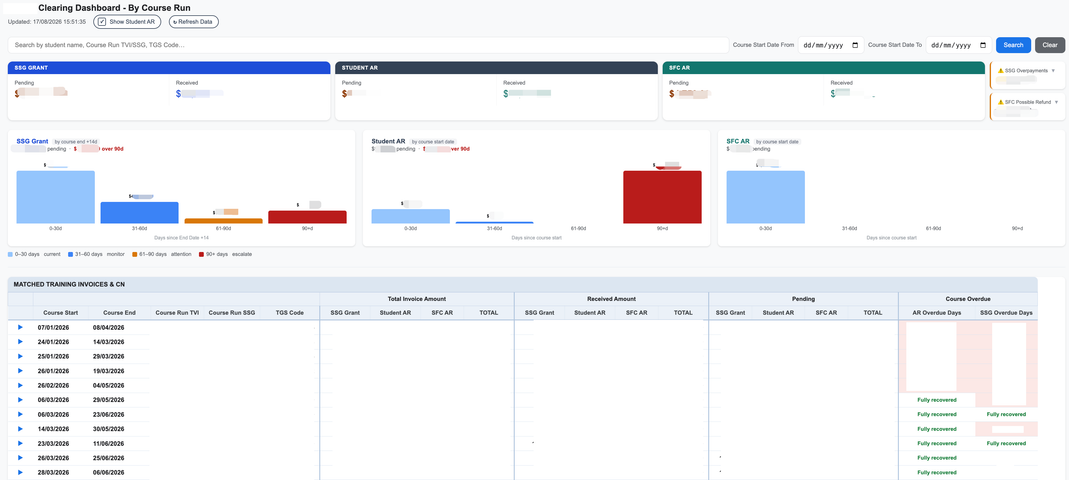
Once the underlying processes were understood and corrected, DFG used AI-assisted development to build the matching and reporting solution around the client's actual operation. 一旦底层流程被理解并纠正,DFG便利用AI辅助开发,围绕客户的实际运营构建了匹配和报告解决方案。
Government disbursements could now be connected with student and course records, giving management clearer visibility over outstanding funding, ageing, expected receipts and cash-flow impact. 政府拨款现在能够与学生和课程记录关联,让管理层对未到位拨款、账龄、预期到账及现金流影响有了更清晰的掌握。
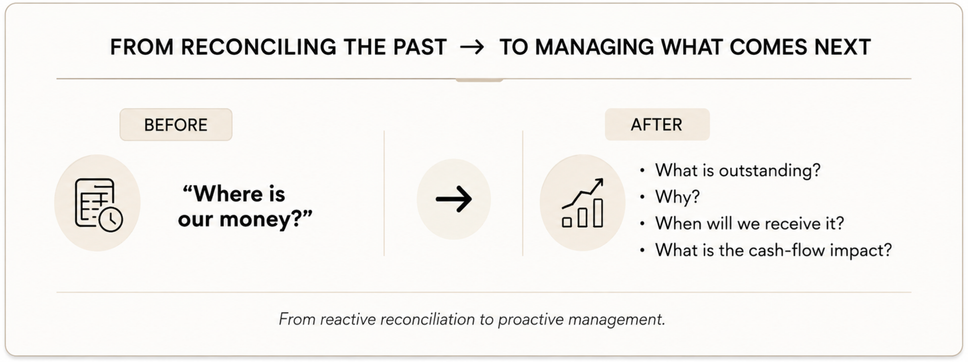
AI helped us build the solution faster. But AI wasn't what identified the problem. AI帮助我们更快地构建了解决方案,但识别问题的并非AI。
The Real Capability Is Problem-Solving 真正的核心能力是解决问题
That required understanding an unfamiliar operational system, tracing transactions across operations and accounting, and identifying exactly where information stopped flowing correctly. 这需要理解一个陌生的运营系统,追踪跨运营与会计的交易流转,并精准找出信息在哪个环节停止了正确流动。
DFG's experience across audit, multinational organisations and growing businesses in different industries, combined with strong technology capability, allows us to approach problems from both a finance and systems perspective. AI gives us the ability to turn that understanding into working solutions faster. DFG在审计、跨国企业及不同行业成长型企业的丰富经验,结合强大的技术能力,使我们能够从财务和系统两个角度切入问题。AI赋予我们将这种理解更快转化为可行解决方案的能力。
Accounting tells us what the numbers should mean.
Systems thinking helps us understand why they don't.
AI helps us turn that understanding into a solution.
会计告诉我们数字应该意味着什么。
系统思维帮助我们理解为何并非如此。
AI帮助我们将这种理解转化为解决方案。