Singapore Corporate Tax: 17% Is Only the Headline 新加坡企业税:17%只是表面数字
1. Singapore Corporate Tax at a Glance 1. 新加坡企业税概览
| Tax Benefit税务优惠 | Qualifying New Company — First 3 YAs符合资格的新公司——前3个课税年度 | Established Company — From 4th YA成熟公司——第4个课税年度起 |
|---|---|---|
| Headline CIT Rate标准企业所得税率 | 17% | 17% |
| Tax Exemption Scheme税务豁免计划 | Start-Up Tax Exemption (SUTE)初创企业税务豁免(SUTE) | Partial Tax Exemption (PTE)部分税务豁免(PTE) |
| First Band第一档 | 75% exemption on first S$100,000 of normal chargeable income对正常应税收入首10万新元享有75%豁免 | 75% exemption on first S$10,000 of normal chargeable income对正常应税收入首1万新元享有75%豁免 |
| Second Band第二档 | 50% exemption on next S$100,000 of normal chargeable income对其后10万新元正常应税收入享有50%豁免 | 50% exemption on next S$190,000 of normal chargeable income对其后19万新元正常应税收入享有50%豁免 |
| Maximum Income Exempted最高豁免收入 | Up to S$125,000 per qualifying YA每个符合资格课税年度最高12.5万新元 | Up to S$102,500 per YA每个课税年度最高10.25万新元 |
| Budget 2026 Relief2026年预算减免 | 50% CIT rebate for YA 2026, subject to overall benefit cap*2026课税年度享50%企业所得税回扣,受整体利益上限约束* | 50% CIT rebate for YA 2026, subject to overall benefit cap*2026课税年度享50%企业所得税回扣,受整体利益上限约束* |
* Overall benefit from the YA 2026 CIT rebate and any CIT Rebate Cash Grant (if eligible) is capped at S$40,000 per company. Illustrated example below: * 2026课税年度企业所得税回扣与企业所得税回扣现金补贴(如符合资格)的整体利益上限为每家公司4万新元。示例如下:
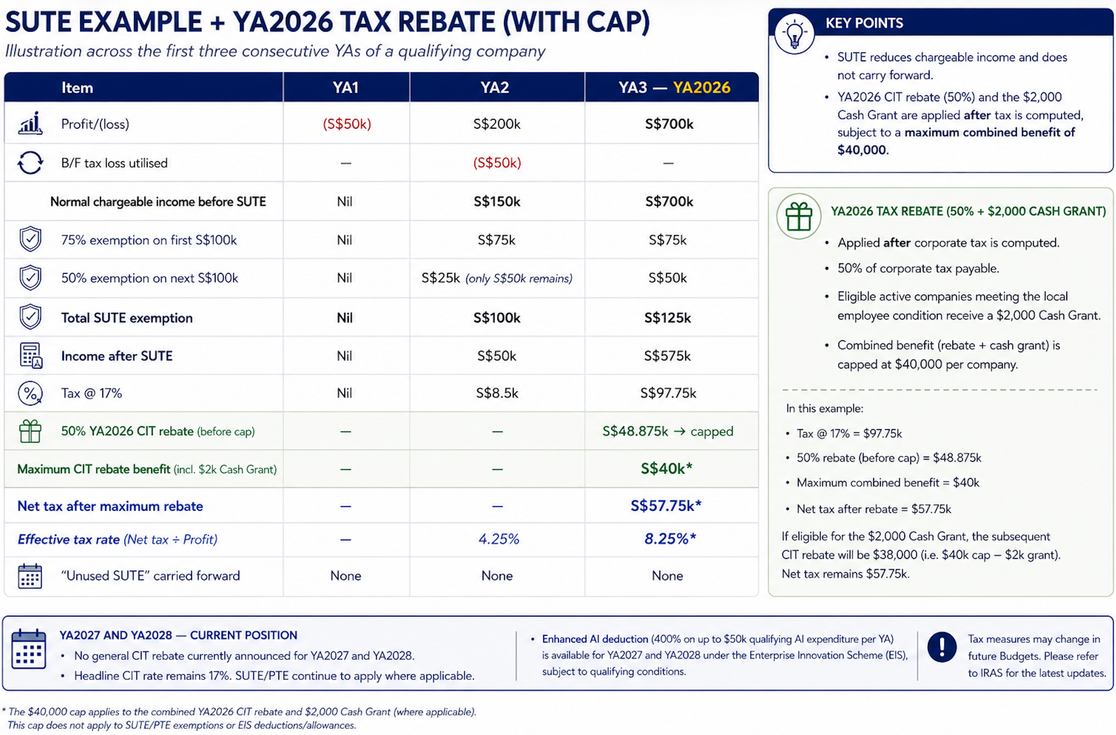
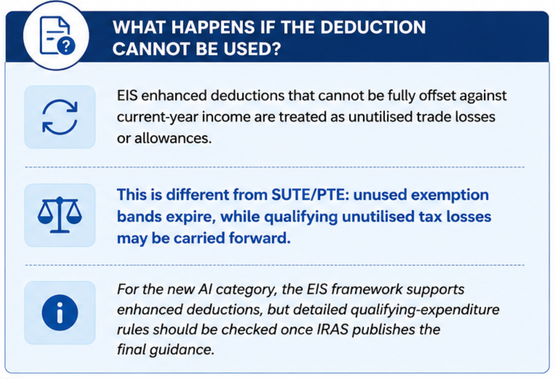
SUTE and PTE follow the same core principle: Both are exemptions applied to normal chargeable income for that YA. If the company has less income than the exemption bands, the unused portion of the bands is not carried forward. Actual unutilised trade losses are different — they may generally be carried forward, subject to the shareholding test. SUTE与PTE遵循相同的核心原则:两者均为适用于该课税年度正常应税收入的豁免。若公司收入低于豁免档位,未使用的档位部分不可结转。实际未使用的贸易亏损则不同——通常可在符合股东测试的前提下结转。
YA2027 and YA2028 — Current Position 2027及2028课税年度——目前立场
No general CIT rebate currently announced for YA2027 and YA2028. Headline CIT rate remains 17%; SUTE/PTE continue to apply where applicable. Enhanced AI deduction (400% on up to S$50k qualifying AI expenditure per YA) is available for YA2027 and YA2028 under the Enterprise Innovation Scheme (EIS), subject to qualifying conditions. 目前未宣布2027及2028课税年度的一般企业所得税回扣。标准税率维持17%;SUTE/PTE在适用情况下继续有效。企业创新计划(EIS)下,2027及2028课税年度可就每课税年度最高5万新元合格AI支出享有400%额外扣税,须符合资格条件。
2. Innovation Is Rewarded 2. 创新获得奖励
The Enterprise Innovation Scheme (EIS) is the umbrella innovation tax scheme available from YA 2024 to YA 2028. R&D is one of its qualifying activities, and qualifying AI expenditure becomes a new EIS activity for YA 2027 and YA 2028. 企业创新计划(EIS)是适用于2024至2028课税年度的综合创新税务计划。研发是其合格活动之一,而合格AI支出从2027及2028课税年度起成为EIS新增合格活动。
Qualifying activities include:合格活动包括:
A start-up may claim SUTE/PTE and EIS together if the respective conditions are met.若分别符合相应条件,初创企业可同时申领SUTE/PTE与EIS。
3. R&D Under EIS 3. EIS下的研发扣税
For qualifying R&D undertaken in Singapore (YA 2024–YA 2028): 对于在新加坡开展的合格研发(2024至2028课税年度):
A qualifying R&D project must:合格研发项目须:
- Have an R&D objective — new knowledge, a new/improved product or process具有研发目标——新知识、新/改良产品或流程
- Involve novelty OR technical risk涉及新颖性或技术风险
- Use systematic, investigative and experimental work in science or technology采用系统性、研究性和实验性的科学或技术工作
Typical qualifying expenditure:典型合格支出:
- Staff costs (excluding directors' fees)员工成本(不含董事费)
- Consumables used in the R&D研发所用消耗品
- Outsourced R&D: generally 60% of service fee, or actual qualifying staff costs + consumables if substantiated and higher外包研发:通常为服务费的60%,或经证实更高时,以实际合格员工成本加消耗品计
Routine testing, market research and routine/cosmetic modifications generally do not qualify.常规测试、市场调研及常规/表面性修改通常不符合资格。
4. New: AI Adoption Under EIS (YA 2027 & YA 2028) 4. 新增:EIS下的AI应用扣税(2027及2028课税年度)
Simple illustration:简单示例:
- S$50,000 qualifying AI expenditure → up to S$200,000 tax deduction5万新元合格AI支出 → 最高20万新元税务扣除
- This is not S$200,000 cash back这不是20万新元的现金返还
- EIS cash-payout option is not available for this AI category此AI类别不适用EIS现金支付选项
Current IRAS Position税务局目前立场
IRAS has confirmed the 400% deduction and S$50,000 annual cap. The current EIS guidance does not yet set out detailed qualifying AI cost categories. Do not assume general AI subscriptions, consultancy, hardware or development costs qualify unless detailed rules confirm them. 税务局已确认400%扣税及每年5万新元上限。现行EIS指引尚未列出详细合格AI成本类别。除非详细规则确认,否则请勿假设一般AI订阅、咨询、硬件或开发费用符合资格。
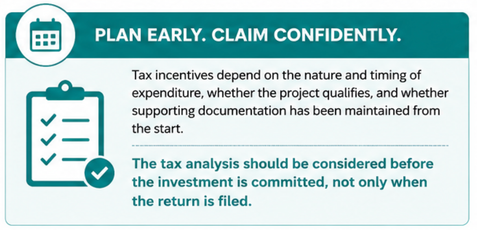
Plan Early. Claim Confidently.提早规划。自信申领。
Tax incentives depend on the nature and timing of expenditure, whether the project qualifies, and whether supporting documentation has been maintained from the start. The tax analysis should be considered before the investment is committed, not only when the return is filed. 税务优惠取决于支出的性质和时间、项目是否符合资格,以及是否从一开始就保存了支持文件。税务分析应在承诺投资之前进行,而不仅仅是在申报时。
5. What If the Company Is Loss-Making? 5. 如果公司出现亏损怎么办?
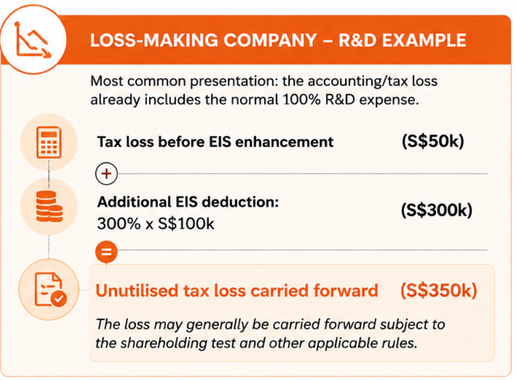
EIS enhanced deductions that cannot be fully offset against current-year income are treated as unutilised trade losses or allowances. 无法完全抵扣当年收入的EIS额外扣税,将被视为未使用的贸易亏损或免税额。
We help businesses understand not only what they need to pay, but also the reliefs and incentives relevant to their business and stage of growth. 我们帮助企业不仅了解需要缴纳的税款,还帮助其了解与其业务和成长阶段相关的减免和激励措施。